
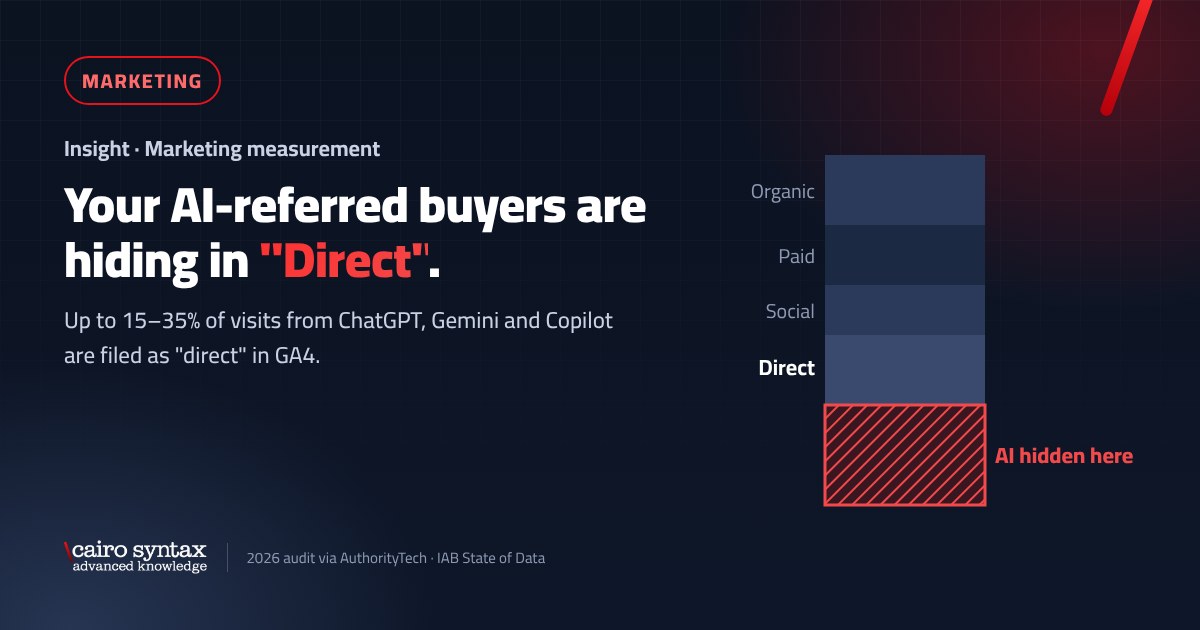
Ask most Egyptian marketing and commercial leaders where their website visitors come from and you'll hear the same three answers: Google, Meta, and "direct." That last bucket — the people who supposedly typed your URL straight into the browser — is quietly becoming the most misleading number on your dashboard. A large and growing share of it isn't direct at all. It's people who asked ChatGPT, Gemini or Copilot a question, got your company as part of the answer, and clicked through. Your analytics just can't see where they came from.
This matters now because the channel has stopped being a rounding error. Traffic from AI search engines grew roughly 16x between 2024 and 2026, rising from 0.02% of all website visits to 0.32% (SE Ranking, 18 Jun 2026). Globally, visits to generative-AI platforms are up about 70% year on year, to 9.5 billion a month (Similarweb, 29 Jul 2026). Still small against Google, but moving faster than any channel your team currently reports on — and it's the channel your dashboard understands worst. Here's what's actually happening, and what to do about it.
1. The "direct" bucket is hiding your AI referrals. When someone arrives from an AI assistant, the platform often strips or obscures the referrer, so Google Analytics 4 has nothing to attribute the visit to and files it under "direct". One 2026 audit put the share of AI-driven traffic misclassified this way at 15–35% (AuthorityTech, 22 Jun 2026). If a third of a fast-growing channel is invisible, every report built on top of GA4 — your channel mix, your cost-per-lead, your "what's working" slide — is quietly wrong.
2. The danger isn't the missing number. It's the decision it drives. A finance-minded marketer looks at a channel showing flat clicks and cuts its budget. But the content and SEO work that looks "dead" in the organic row is often exactly what the AI assistants are reading and citing when they recommend you. Cut it, and you starve the channel that was quietly sending you your best-fit buyers — while the dashboard congratulates you for trimming waste. The IAB's 2026 survey found 75% of buy-side leaders now say their attribution, incrementality and mix-modelling underperform (AuthorityTech, 22 Jun 2026). This is why.
3. AI-referred visitors are usually further down the funnel. Someone who clicks through from an AI answer has already had their question researched and your company pre-qualified by the assistant. For a B2B training or services buyer, that's a warmer lead than a cold ad click — someone arriving ready to ask about scope, not "what do you do?" If you can't even identify the channel, you can't see that it converts better, and you'll keep valuing it at zero.
4. GA4's new AI features won't save a messy setup. Google's August 2026 updates are genuinely useful — custom conversion windows from 1 to 90 days (so a 67-day B2B buying journey isn't cut off at 7), AI-written summaries, and a validation report for imported campaign data (devrun, 2026). But as that write-up puts it, "AI can accelerate analysis; it cannot turn inconsistent measurement into trustworthy measurement." Pointing a smarter model at a report that files a third of your demand as "direct" just gives you confident, wrong answers faster.
5. The fix is a habit, not a licence. You don't need to buy another platform. You need three disciplines your existing team can learn in a day: a custom channel group in GA4 that catches the known AI referrers (chatgpt.com, gemini, perplexity, copilot and the rest) so they stop hiding in "direct"; strict UTM tagging on every link you control, so paid and organic never blur; and a quarterly measurement audit that checks referrer coverage and re-reads what the channel mix is really telling you. With marketing budgets up just 1.3% this year (Gartner, via devrun), getting the measurement right is cheaper than getting the spend wrong.
The takeaway: AI assistants are now a real demand channel, and for most teams it's the one the dashboard describes worst. The companies that win the next two years won't be the ones with the fanciest analytics stack — they'll be the ones whose marketers can look at a "direct" spike and know to ask why. That's a skill, and it's teachable.
How Cairo Syntax helps. We run a marketing-measurement programme for your marketing and commercial team — on your own GA4 property, in Arabic and English. Your people leave able to build an AI-referral channel group, tighten UTM tracking, read attribution honestly, and run a quarterly audit, with a 30-day re-check so the new reporting discipline actually holds. It's built for exactly this moment: teams whose dashboards are undercounting the channel that's growing fastest.
See our digital marketing and measurement training for teams.
One next step: book a free 45-minute diagnostic and we'll audit how your website traffic is being classified today — and show you how much of your "direct" is really AI. → cairosyntax.com/book.php