
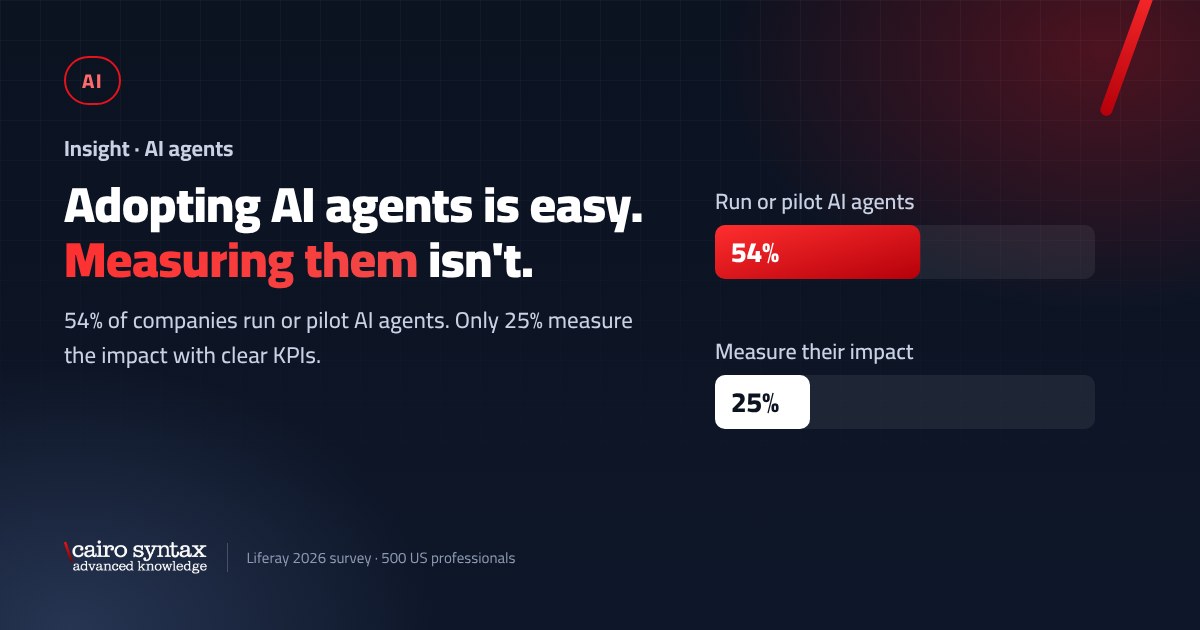
There is a number every Egyptian business leader should sit with this quarter. In a 2026 survey of 500 US professionals involved in AI decisions, 54% said their company is already running or piloting AI agents — software that doesn't just answer a question but carries out a task end to end. But only 25% said they measure that AI's impact with clear KPIs (Liferay, 12 Aug 2026). More than half are spending on agents. One in four can actually say whether it paid off.
That gap — between how fast companies adopt AI and how slowly they learn to govern and measure it — is the real story of enterprise AI right now. And it's not a technology problem. It's a management one. The survey is American, but the pattern is the one we see in Egyptian companies too. Here's what it means for a firm in Cairo, and what to fix before you scale.
1. Adoption has outrun measurement, and the gap is the risk. Running an agent is easy now; knowing if it earns its keep is not. When only a quarter of adopters have clear KPIs, most AI spend is being judged on vibes — "it feels faster" — not on a number a finance director would accept. Gartner expects this to catch up with people: it forecasts that more than 40% of agentic AI projects will be scrapped by the end of 2027, driven by escalating costs, unclear business value and inadequate risk controls (Gartner, 25 Jun 2025). The projects that die rarely fail on the technology. They fail because no one defined what "working" meant before switching it on.
2. You're scaling capability — but also scaling risk. In the same survey, only 24% of companies had a company-wide AI usage policy, while security and privacy were the single biggest barrier to getting more value (30%), and data privacy the top concern about agents overall (21%). For an Egyptian company that matters twice over, because an agent that reads customer or employee data falls squarely under the Personal Data Protection Law (151/2020). Deploying agents across the business without a written policy on what data they may touch, what they may decide alone, and what a human must approve isn't speed — it's unmanaged exposure dressed up as progress.
3. "Better accuracy" is the ask — and it's mostly your problem, not the model's. 42% of respondents said the thing agents need most is better accuracy. But in practice an agent is only as accurate as the instructions and the data it's given. A finance agent pointed at a clean, well-defined dataset with a sharp prompt is reliable; the same agent let loose on a messy export with a vague request produces confident, wrong answers at scale. Accuracy is less a feature you wait for and more a discipline you build — in how your people brief the tool and check its output.
4. In Egypt, the gap is skills, not engineers. You don't need to hire an AI team to close this. "AI" is already appearing as a required skill inside ordinary Egyptian job ads — sales, regulatory, HR, export, operations — with 118 open postings tagged to it on one major board in early October, sampled mostly in non-technical roles (Wuzzuf, recorded 7 Oct 2026). The market has already decided: the people who need to use agents well are your existing managers and specialists, not a new cadre of data scientists. The barrier the survey named third — 27% cited lack of training — is the one you can remove fastest and cheapest.
5. The fix is cheap, human, and this-quarter. Three habits move a company from the unmeasured 75% to the disciplined 25%. First, before any agent goes live, write down the one number it should move — hours saved on a report, error rate on an invoice run, response time on a quote — and measure it at 30 days. Second, give the business a one-page AI usage policy: what data agents may use, what they may decide, what a human signs off. Third, train the people who'll actually use them to write a good instruction and catch a wrong answer. None of this requires a new platform. It requires a decision to treat AI as something you manage, not something you merely own.
The takeaway: the companies that win with AI over the next two years won't be the ones that deployed the most agents. They'll be the ones that could prove, in a number, which agents were worth keeping — and had the policy and the trained people to run the rest safely. Half your market is already in the race. The quarter that measures is the quarter that will still be running agents in 2027.
How Cairo Syntax helps. Our AI for Managers program is built for exactly this gap: it teaches your finance, ops and HR leaders to put AI to work on their own tasks, define a KPI for each use, write a one-page usage policy that respects the Personal Data Protection Law, and judge an agent's output rather than trust it blindly. It runs in Arabic and English, on your own workflows, with a 30-day re-check so the measurement habit actually holds.
If you want a practical start for your managers, see our AI Training for Managers program.
One next step: book a free 45-minute diagnostic and we'll map where AI agents would safely earn their keep in your business — and where you need a policy or cleaner data first. → cairosyntax.com/book.php